


PPS (Programmable Power Supply), AVS (Adjustable Voltage Supply)
The PPS charging protocol was implemented with USB PD3.0.
Thanks to the PPS, devices can gradually adjust the current and voltage in such a way that the device receives the best possible charging supply. PPS also ensures that you charge efficiently (almost eliminating DC-DC conversion while charging the battery), generate less heat, and, as a result, maintain the health of your battery.
It has variable voltages instead of the fixed 5V/9V/15V/20V profiles in USB-PD. The voltage varies from 3.3 to 21 V in 20 mV (0.02V) steps and a current is specified in 50 mA steps to facilitate constant-voltage and constant-current charging. Data about changing supplying power is sent between the charger and the charging device every 10 seconds.
Charging modes for the latest PD3.2 PPS:
-
3.3-5.9V/3A
-
3.3-11V/3A
-
3.3-16V/3A
-
3.3-21V/3A
-
3.3-21V/5A (requires 5A cable)
Some charger manufacturers implement a limited PPS range with max 20V which may not be compatible with devices requiring a maximum voltage of 21V in the PPS.
However implementing full PPS voltage range in low power chargers <110W creates the "power cliff" issue, which means that the max current level available only at max voltage and it is the same for the all voltages in PPS range, for example if 45W charger has PPS range 3.3-21V2.15A, the 2.15A limit will be at any voltage, for example at 9V with the resulting output power = 19.35W.
The AVS charging protocol was implemented with USB PD 3.1 and extended with PD3.2 allowing it to work within the standard power range (SPR) below 100W, down to a minimum of 9V.
In addition, under the Extended Power Range (EPR) mode, PD 3.2 allow to implement “Peak current” functionality, enabling power supplies to safely handle short bursts of high-power loads—such as those required during heavy computing on high-performance laptops or smartphone charging at the beginning of the charging curve (in the middle and at the end of charging cycle power demand is decreasing).
AVS charging modes for the latest PD 3.2:
-
(SPR AVS) 9-15V - 3A (27-45W)
-
(SPR AVS) 9-20V - 3A (45-60W)
-
(SPR AVS) 9-20V - 5A (60-100W) - requires 5A cable
-
(EPR AVS) 15-28V - 5A (up to 140W) - requires 5A EPR cable with e-maker chip
-
(EPR AVS) 15-36V - 5A (up to 180W) - requires 5A EPR cable with e-maker chip
-
(EPR AVS) 15-48V - 5A (up to 240W) - requires 5A EPR cable with e-maker chip
Known USB chargers with PD 3.2 AVS SPR support:
-
Google Pixel Flex Dual Port 67W 2C - charging adapter supports PD3.2 SPR AVS (9–15V/4A, 15–20V/3.35A), PPS (11V/3A, 16V/4A, 21V/3.35A), and PD (5V/3A, 9V/3A, 15V/4A, 20V/3.35A).
-
Apple 40W (60W peak DPS) Dynamic Power Adapter - supports AVS 9-15V2.65A (3A peak), 15-20V/2A (3A peak), PD 5V3A, 9V3A). The adapter can handle 48W (20V2.4A) without any problems, and at a load of 60W DPS (20V3A) it can operate for about 20 minutes (depending on the ambient temperature), after which the power drops to the base 40W.
-
CUKTECH 10 Super Magnetic Power Card (WPB100P) - 45W (9-15V/3A)
-
CUKTECH 25 Power Bank SE 13.5mAh 120W - 100W (9-20V3A, 5A) (embedded cable)
-
Momax 45W 3in1 power bank model IP167. Input (retractable UsbC cable and UsbC2 - AVS 30W (9-20V/2A)), output (retractable UsbC cable and UsbC2 - AVS 45W (9-20V/3A))
AVS vs PPS. AVS is similar to PPS in terms of dynamic charge voltage regulation and direct battery charging without unnecessary voltage conversion, but the difference is that AVS does not support Current Limit operation, and the output voltage is adjusted in a unit step of 100mV (which is more practical than 20mV for PPS because it better withstand electrical interference, such as cable loss and voltage ripple, ensuring the stability of voltage adjustment). PPS is limited to a maximum current of 100W, while AVS EPR can reach 240W.
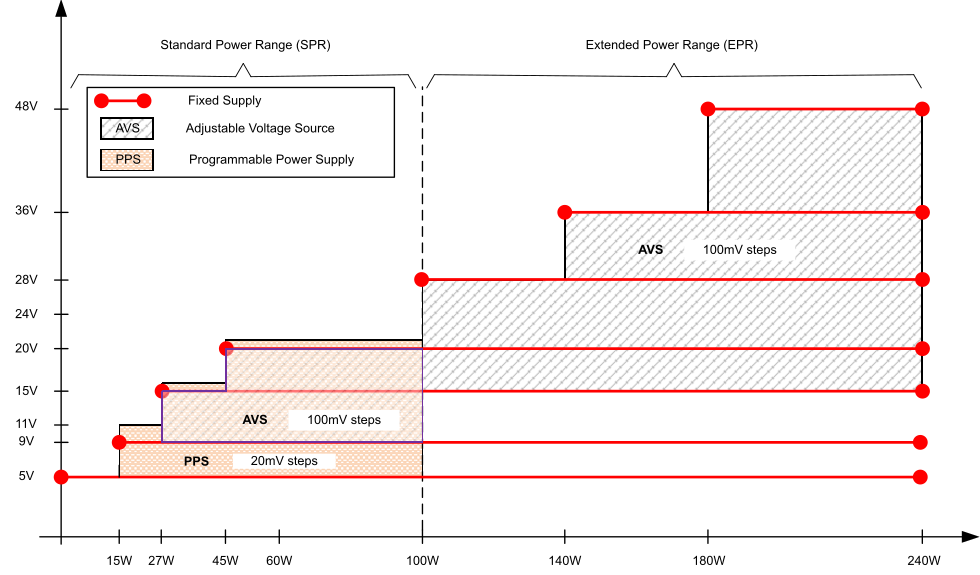
Diagram source: https://www.ti.com/document-viewer/lit/html/SSZTD49
Other facts:
-
Qualcomm Quick Charge 5 is USB-PD PPS
-
Any USB-IF Certified Fast Charger must include PPS
-
MediaTek's Pump Express (PE) 4.0 also relies on USB-PD PPS
-
It is important to know that many chargers that claim fast charging functionality often do not achieve the top charging speed for devices from Samsung, for example. Samsung Galaxy devices (S20 and above) require a charger that has PPS technology to use Super Fast Charging (SFC)
-
Official Power Delivery documentation
-
Smartphone manufacturer Nubia uses a modification of the PPS protocol to achieve a charge of up to 165W (3.6-20V/8.25A), which requires the use of a proprietary charger and proprietary UsbC-UsbC 9A cable. The Nubia charger supports standard PD and PPS protocols, while the Nubia smartphone can be charged by some third-party chargers via PD/PPS protocols (up to 90W).
-
Vivo Y300 Pro supports PPS up to 35W (9V)
-
Vivo X100 Pro well supports PPS charging. In case up to 11V5A charging range you may get 30-40W, with range up to 21V5A you may get almost 80W (there is no confirmation, but it supposed that 20V5A range might give around 65W).
-
Vivo X200 Pro supports PPS charging 11V5A (around 45W), other ranges are not supported. Using PD charging at fixed voltages you can get 9V3A (11W max).
-
The Infinfix Note 50 pro supports PPS 11V5A charging (approximately 34W). When charging from the PD protocol, charging is possible at a fixed PDO of 5V, 9V3A (17W max).
-
Xiaomi 12S Pro (in addition to the proprietary charging protocol) supports PPS ranges up to 11V and 16V (actual charging power around 15W) and PD 9V (power around 9W).
-
Xiaomi 13 Ultra/Pro (in addition to the proprietary charging protocol) supports PPS ranges up to 11V (actual charging power is about 22W) and PD 9V (power is about 12W).
-
Xiaomi 15 Pro (in addition to the proprietary charging protocol) supports PPS ranges up to 11V (actual charging power about 26W) and PD 9V (power about 13W)
-
Xiaomi 17 Pro Max (in addition to the proprietary charging protocol) supports PPS ranges up to 11V5A (actual charging power about 43W), up to 20V/21V with actual power 53W(3A) and 78W(5A), and PD 9V (power about 15W)
-
Google Pixel 9 Pro requires PPS 11V to reach 27W charging power
-
Google Pixel 9 Pro XL requires PPS 21V to reach 37W charging power, while PPS 20V options are not accepted by the device and if there is no PPS 21V, the charging is doing at PPS 11V. Supporting PPS up to 21V is not a very common case among usb chargers, but there are some model available.
-
Google Pixel 10, 10 Pro, 10 Pro Fold require PPS 11V to reach 27W charging power
-
Google Pixel 10 Pro XL requires PPS 21V to activate the maximum charging power of 37W (rapid charging), real charging speed is about 34W, if a charger support PPS range up to 9V, 16V or 20V the smartphone activate only PPS 9V and charging max power is up to 25W, if a charger support PD charging only, the activates 9V and max charging power is 18W). Regular 3A cable is enough for charging at any protocol.
-
Along with the release of the iPhone 17 Pro and 17 Pro Max, Apple launched a 40‑watt (Dynamic Power Adapter with support for 60W peak power (up to 30 minutes) and the PD3.2 SPR AVS protocol.
-
The nuances of using the PPS protocol for Samsung smartphones (in particular how to get 45W charging) can be found in the article about the SFC protocol.