

Soldering tools
Soldering iron, hot air gun, spot welder
Soldering iron
For electronics hobbyists, a soldering iron is as essential as a multimeter, and it is just as useful for household tasks.
In everyday use, a soldering iron can be used to:
-
connect two wires to extend a cable (for example, when an extension lead is one meter too short and buying a new one makes little sense). Twisting such wires is not an option: the current can be high.
-
solder a wire to a contact without a screw clamp. A twisted connection may work temporarily, but over time it can oxidize and loosen. The current then flows through a smaller contact area, causing overheating and potentially dangerous consequences.
-
desolder a wire or component. Because soldering forms a very reliable joint, soldered parts usually have to be heated before they can be separated (unless you physically remove the joint).
I want to highlight the TS100/TS101 soldering irons, which I've been using for years (I own both). They are a pleasure to use - the Mercedes of soldering irons. They are incredibly compact and powerful. Heating speed depends on the power source: use a 24V power supply for faster heating, or connect a >140W USB-C charger with PD 3.1 (28V3.2A) to reach up to 90W. The iron has temperature control and a motion sensor that saves energy while idle and can turn the iron off after a set period.
This video shows how to update the firmware on the TS100.
Firmware update instructions + the latest IronOS firmware.
Official firmware for TS100/TS101 from the manufacturer.
Accessories for TS100/TS101:
-
I use a convenient M-shaped stand specifically designed for the TS100.
-
Another useful accessory for the TS100 is USB Type C to DC 20V 3A PD Emulator Trigger silicone cable 1.5m. This flexible, heat-resistant USBC-DC5525 cable is specifically designed for the TS100. It connects to a USB-C adapter, requests 20V, and supplies that voltage to the soldering iron through a standard DC 5525 connector. This saves desk space and eliminates the need for an extra power adapter.
-
The case for the soldering iron and accessories (charger, cable, solder, etc.)
My latest purchase is the Miniware TS21. It is a precision soldering iron for fine work with a short C210/T210 tip. It delivers up to 100W with PD 20V5A through USB-C and also supports PD 9V, which can be useful when using a power bank. Heating is extremely fast - about 3 seconds with a 60-100W power source. The latest firmware can be downloaded from the official website.
Hot air gun
Compact soldering irons are also available in 5V USB-powered and propane-butane gas-powered versions. I bought the gas model not primarily as a soldering iron, but for hot-air tasks: the included nozzle works well for heating heat-shrink tubing. Since buying an electric hot air gun, I use the gas tool only in the field. It can be refilled with standard lighter gas.
Spot welder
For projects involving Li-ion battery packs built from 18650 cells, I needed a spot welder because soldering cells is inconvenient and potentially dangerous: they can overheat. I like the tool - assembly is roughly five times faster than soldering, and the result is neater.


Soldering and desoldering
Solder and flux
To start soldering, you need solder.
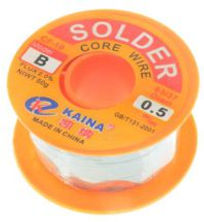
Chinese solder is very good and already contains flux.
Solder wire is available in different diameters, typically from 0.4mm to 2mm. I use 0.8mm because it makes it easy to control the amount of solder.
You may also need separate flux, for example, to prepare the joint and ensure good soldering. Flux removes oxides from metal surfaces and helps solder adhere.
Fluxes are commonly available as solids, acid-based liquids that require careful handling and cleanup after soldering, and rosin dissolved in alcohol. I recommend the last option because it is safe for board components and usually does not require cleaning after use.
How to remove solder?
-
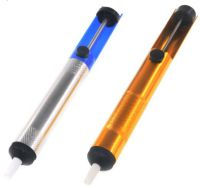
The easiest way to remove solder is with a desoldering pump: either a mechanical one or an electric pump.
-
Another method uses braided copper desoldering wick. It acts like a sponge: place it on the solder joint and heat it with the soldering iron, and the molten solder is absorbed into the braid.

Cleaning a soldering iron tip
During soldering, residue builds up on the soldering iron tip, and excess solder can also accumulate. It is best to clean the tip before the next soldering job or when you finish working. Tip-cleaning accessories are used for this.
The most common methods are a metal mesh cleaner or a sponge.
The metal mesh should sit in a dedicated cup or container so it stays in place instead of rolling across the desk while you clean the tip. An ordinary kitchen metal scrubber can also work.
In my view, a sponge is a more convenient and tidy solution. It comes as thin, dry sheets that you wet before use; they expand when moistened. The tip cleans well on a slightly damp sponge. These sponges are inexpensive and reusable.


"Third hand"
This is an auxiliary tool that uses alligator clips to hold wires, circuit boards, and other parts during soldering. It can also be useful for other work, but it is especially helpful when soldering.
For example, it can hold two wires parallel, leaving both hands free for the soldering iron and solder wire.
It is also useful for holding a board with components in place before soldering and for desoldering components from a board.
A magnifying glass is useful when you need to inspect solder joints or markings on electronic components closely.
If you solder from time to time, it is worth considering - it is very convenient.
There are many versions of this tool. For completeness, I show both a relatively simple version and a more advanced one with a magnifying glass, separate lighting, and an exhaust fan that directs flux fumes away from your face. I use a universal version with flexible arms, a magnifying glass with built-in lighting, and a fan.


Workstation setup and additional accessories
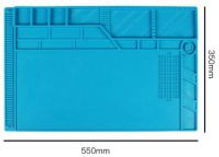
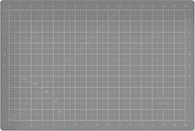
When soldering, drops of molten solder can fall onto the desk, so the work surface should be protected. You can use a sheet of plywood or, much more conveniently, a dedicated heat-resistant work mat. It tolerates contact with a hot soldering iron, and solder drops do not stick or leave marks. Larger mats often have magnetic compartments with raised edges that are useful when disassembling devices, such as a computer, and keeping screws together. Overall, the mat is versatile, easy to roll up and store, and lets you solder even at a kitchen table without damaging the furniture.
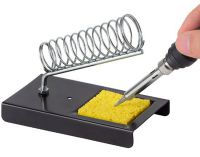
I also recommend a soldering iron stand with a recess for a tip-cleaning sponge. It is useful because the tip gets extremely hot, and the iron can easily tip forward and scorch the work surface. Some "third hand" setups also include a soldering iron holder and sponge.
Another important accessory is heat-shrink tubing. It is convenient for insulating wires and contacts and is much better than electrical tape because it does not unravel; the finished insulation looks clean and professional.
Heat-shrink tubing comes in different diameters. A common shrink ratio is 2:1. Remember that it also shrinks lengthwise, typically by about 15-20%.
To shrink the tubing, heat it. I do not recommend matches or a lighter: matches burn out quickly and can burn your fingers, while a lighter heats up and can soot-stain the tubing. The best option is a hot air gun, either as part of a soldering station or as a separate tool. For occasional use, I bought the gas burner mentioned above in the soldering iron section.
To keep your toolbox organized, I recommend buying the tubing as a set in a plastic case.