
Y-type 2-in-1 USB-C cables
-
[Anker 2-in-1 140W] • TBT n/a • USB2.0 • 480Mbps • PD3.1 • 140W • Braided
-
[Cable Matters 2-in-1 140W] • TBT n/a • USB2.0 • 480Mbps • PD3.1 • 140W • Braided
-
[Club3D CAC-1527 2-in-1] • TBT n/a • USB2.0 • 480Mbps • PD3.0 • 100W • Braided
-
👍[CUKTECH 2-in-1 No.10] • TBT n/a • USB2.0 • 480Mbps • PD3.0 • 100W • Xiaomi • Braided
-
👍[CUKTECH 10 Plus 140W PD3.2 2-in-1] • TBT n/a • USB2.0 • 480Mbps • PD3.2 • 140W • Xiaomi • Braided
Anker 2-in-1 140W PD3.1
Key product features:
-
Flexibility: flexible
-
Surface: nylon braided
-
Color: black/white
-
Max power: PD 3.1 EPR 140W
-
USB standard: USB 2.0 (480Mbps)
-
Thunderbolt: not supported
-
Length: 1.2/1.8 m (4/6ft)
-
Resistance: not applicable due to the power circuit in the cable.
-
The cable does not add charging protocols that the charger itself does not support. For example, if the charger provides only PD65W without PPS, the cable will also provide only PD65W without PPS. The cable may also limit the set of charging protocols available from the charger.
-
Testing confirmed support for PD 3.1, PPS, FCP, SCP, QC4/5, Sam2A, Apple2.4, and DCP. PD AVS, AFC, and QC2/3 are not supported.
-
With one device connected, the full charging capability is available (for example, PD140W), with a small reserve for the cable's electronics.


-
Of the two connected devices, the one with the higher maximum power demand determines the charging protocol requested from the charger and the maximum available power. For example, if a PD100W laptop and a PD27W smartphone are connected, the cable requests PD100W from the charger and then distributes that power between the laptop and smartphone, even if the charger can supply 140W.
-
If two smartphones are connected and each supports up to PD27W, the cable requests only PD27W from the charger and then distributes it between the devices.
-
When a second device is connected, the available power is split equally between the connected devices. For example, with a PD100W laptop and a PD27W smartphone, the laptop switches to PD50W while the smartphone receives PD27W. Even if the second device requires only 5W, the laptop remains limited to 50% of its maximum power. With two PD27W smartphones, each switches to PD13W.
-
Different output voltages are supported for the two devices (for example, 20V and 9V).
-
Connecting a second device does not interrupt power; only the charging protocol changes.
You can buy this item here:
Cable Matters 2-in-1 Y-cable PD3.1 140W USB2.0
Key product features:
-
Flexibility: relatively flexible
-
Surface: braided nylon
-
Color: black
-
Max power: PD 3.1 140W
-
USB standard: USB 2.0 (480Mbps)
-
Thunderbolt: not supported
-
Length: 1.8 m (6ft)
-
Resistance: not applicable due to the power circuit in the cable.


-
Testing has confirmed support for the following protocols: QC3.0, FCP, SCP, MTK PE+, MTK PE+2.0, PD 3.1, PPS, QC5.0, DCP, Samsung2A, Apple 2.4A.
-
QC2.0, AFC, and PD AVS are not supported, even if they are available when connected directly to the charger.
-
The cable does not add charging protocols that the charger itself does not support. For example, if the charger is limited to PD65W without PPS, connecting the cable will not make PPS available, unlike the comparable CUKTECH cable.
-
The maximum power observed in testing with a laptop capable of using 90W via PD was 90W via PD 3.0 (the second cable output was not connected).
-
When the laptop and smartphone were connected simultaneously, the laptop switched to the PD50W protocol, and the smartphone received PD13W (without PPS).
-
When only one smartphone was connected, the PPS protocol was enabled with a maximum power of up to 30W (9V-3.4A).
-
The E-marker chip was not detected on any of the cable connectors, while the activation of the PD90W protocol indicates that the functionality of the E-marker chip is implemented differently than in conventional PD 5A cables.
-
When the second device is connected or disconnected, both devices lose power for a fraction of a second while the charging protocols are renegotiated.
-
When two smartphones that individually support PPS are connected at the same time, PPS is not activated on either device. Both use fixed PD13W (9V1.5A), even though the same phones can negotiate more than 13W via PD 3.0 on chargers without PPS support.

You can buy this item here:
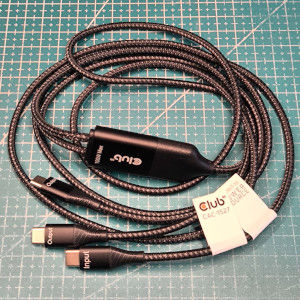
Club3D CAC-1527 2-in-1 Y-cable 100W
Key product features:
-
Flexibility: flexible
-
Surface: braided nylon
-
Color: black
-
Max power: PD 3.0 100W (20V5A)
-
USB standard: USB 2.0
-
Thunderbolt: not supported
-
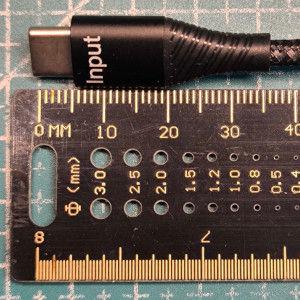
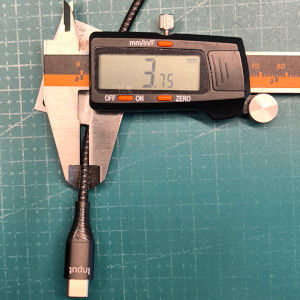
Length: 1.83 m (6ft)
-
Resistance: not applicable due to the power circuit in the cable.
-
The cable does not add charging protocols that the charger itself does not support. For example, if the charger is limited to PD65W without PPS, connecting the cable will not make PPS available, unlike the comparable CUKTECH cable.
-
Testing has determined support for PD 3.0, PPS, FCP, SCP, QC4/5, MTK PE+, MTK PE+2.0, Sam2A, Apple2.4, and DCP.
-
PD AVS, AFC, and QC2/3 are not supported, even if they are available when connected directly to the charger.
-
The maximum power observed in testing with a laptop capable of using 90W via PD was 90W via PD 3.0 (the second cable output was not connected).
-
When the laptop and smartphone were connected simultaneously, the laptop was switched to the PD65W protocol, and the smartphone received PD18W (without PPS).
-
With two smartphones connected, PPS was not activated. Both used PD, limited to PD13W and a maximum current of 1.5A.
-
When only one smartphone was connected, the PPS protocol was enabled with a maximum power of up to 40W (9V-4.5A).
-
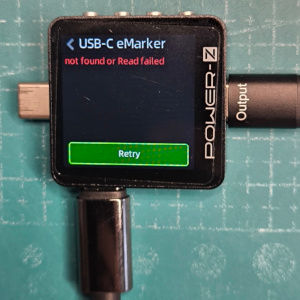
The E-marker chip was not detected on any of the cable plugs, while the activation of the PD90W protocol indicates that the functionality of the E-marker chip is implemented differently than in conventional PD 5A cables.
-
When the second device is connected or disconnected, both devices lose power for 2-3 seconds while the charging protocols are renegotiated.
You can buy this item here:
CUKTECH No.10 2-in-1 100W PD3.0
Key product features:
-
Flexibility: relatively flexible
-
Surface: braided nylon
-
Color: black
-
Max power: 100W PD 3.0
-
USB standard: USB 2.0 (480Mbps)
-
Thunderbolt: not supported
-
Length: 1.3 m (4.3ft)
-
Resistance: not applicable due to the power circuit in the cable.
-
The cable is unique because it accepts up to 100W of input power via USB PD and then converts it to the following charging protocols:
-
PD: 5,9,12,15V-3A, 20V5A
-
PD PPS: 5-11V5A, 5-20V4.5A
-
Xiaomi: 90W
-
QC2.0: 5,9,12V
-
QC3.0: 3.6-12V
-
Samsung 2.0
-
Apple2.4
-
DCP
-
Xiaomi's proprietary charging protocol is also available when powered by less powerful (<100W) chargers.


-
When one device is connected (the second plug must not be connected), the full charging capability is available, for example PD100W.
-
When two devices are connected, the power is distributed in the following proportions:
-
100W input: 70W+30W
-
65W input: 45W+20W
-
45W input: 25W+20W
-
30W input: 10W+10W
-
20W input and below: even distribution between devices
-
-
When a second device is connected, power to the first device (which is already receiving power) is not interrupted.
-
This cable therefore provides a unique capability: it can quickly charge two USB-C devices at the same time and can also provide charging protocols, such as PPS or Xiaomi, that may not be available directly from the USB power adapter.
You can buy this item here:
CUKTECH 10 Plus 140W PD3.2 2-in-1
Key product features:
-
Flexibility: relatively flexible
-
Surface: braided nylon
-
Color: black
-
Max power: 140W PD 3.2
-
USB standard: USB 2.0 (480Mbps through C1 port)
-
Thunderbolt: not supported
-
Length: 1.5 m (5ft)
-
Resistance: not applicable due to the power circuit in the cable.
-
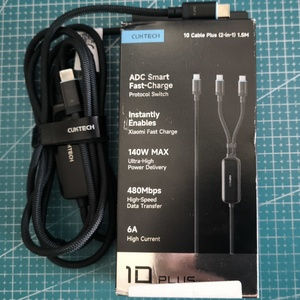
The cable is unique because it accepts power from any charger via USB PD and then converts it to the following charging protocols:
-
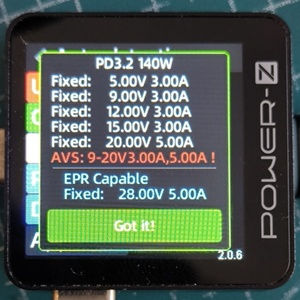
PD 3.1 140W: 5,9,12,15V-3A, 20V5A, 28V5A
-
PD 3.2 AVS SPR 9-20V3A, 5A
-
PD PPS: 5-11V5A, 5-20V5A
-
UFCS 1.0 44W: 5.5-11V4A
-
Xiaomi: 120W (5-11V6A, 5-20V6A)
-
QC2.0: 5,9,12V
-
QC3.0: 3.6-12V
-
FCP 18W 5.2V2A, 9V2A, 12V1.5A
-
SCP 22W 3.3-10V, 0.03A-2.2A
-
AFC 24W 5V2A, 9V2A, 12V2A
-
Samsung 2.0
-
Apple2.4
-
DCP
-
Xiaomi's proprietary charging protocol, as well as PD3.2 AVS and PPS, are also available when powered by less powerful (<140W) chargers, for example, a 45W charger.



-
When only one device is connected, the full 140W is available, for example, PD 3.1 140W.
-
When two devices are connected, the power is distributed in the following proportions (information from the manufacturer):
-
140W input: 112W + 25W
-
100W input: 70W+30W
-
65W input: 45W+20W
-
45W input: 25W+20W
-
35W input: 17.5W+17.5W
-
30W input: 15W+15W
-
20W input and below: even distribution between devices
-
When a second device is connected, power to the first device (which is already receiving power) is not interrupted. So, the cable ensures reset-free power distribution.
Conclusion. This cable provides a unique capability: it converts power from any PD adapter (for example, an Apple adapter) into other charging protocols that the original adapter does not have, for example PD3.2 AVS SPR, PPS, Xiaomi Surge Charge, UFCS, and a few others, and splits power between USB-C ends in a very convenient proportion.