


PPS (Programmable Power Supply), AVS (Adjustable Voltage Supply)
The PPS protocol was introduced with USB PD 3.0.
PPS allows a device to dynamically request voltage and current limits according to the battery's current charging conditions. This can reduce voltage-conversion losses, lower heat generation, and improve charging efficiency.
With PPS, the source provides a programmable voltage range instead of only fixed PDOs. Voltage is adjusted in 20mV steps , and the current limit in 50mA steps . The range can extend up to 3.3-21V depending on the source capabilities. The parameters can be changed dynamically during charging.
The following charging modes are defined by the latest PD 3.2 PPS standard:
-
3.3-5.9V/3A
-
3.3-11V/3A
-
3.3-16V/3A
-
3.3-21V/3A
-
3.3-21V/5A (requires 5A cable)
Some charger manufacturers implement a limited PPS range up to 20V, which may be incompatible with devices that require a maximum PPS voltage of 21V.
With a wide PPS range, lower-power chargers can encounter a so-called power cliff: the maximum APDO current is limited by the source power at the upper voltage boundary, and that current limit then applies across the entire range. For example, if a charger advertises PPS 3.3-21V/2.1A, its maximum power at 9V within that range is about 18.9W.
The PPS protocol is widely used by manufacturers of charging adapters and power banks, though there are some exceptions. Typically, these exceptions stem from specific use cases where PPS support is not required. For example, this applies to some PD chargers for laptops, as well as Apple adapters and accessories designed for Apple devices. Specifically, Anker produces a separate line of chargers for Apple devices that do not support PPS, although this protocol is present in the brand’s other models.
AVS was introduced in USB PD 3.1 for the EPR range. In PD 3.2, AVS was extended to the SPR range up to 100W, with a minimum voltage of 9V.
The Peak Current feature is defined for AVS and allows a power source to advertise its ability to provide increased current for short periods, for example, during brief load peaks in computer systems.
AVS charging modes defined by the latest PD 3.2 standard:
-
SPR AVS 9-15V - up to 3A, for 27-45W sources
-
SPR AVS 9-20V - up to 3A, for 45-60W sources
-
SPR AVS 9-20V - up to 5A, for 60-100W sources; currents above 3A require a 5A cable with an e-marker chip
-
EPR AVS 15-28V - up to 5A, up to 140W - requires a 5A EPR cable with an e-marker chip
-
EPR AVS 15-36V - up to 5A, up to 180W - requires a 5A EPR cable with an e-marker chip
-
EPR AVS 15-48V - up to 5A, up to 240W - requires a 5A EPR cable with an e-marker chip
AVS or PPS? Both modes provide programmable voltage adjustment, but they are intended for different use cases. PPS supports a programmable current limit in 50mA steps and voltage adjustment in 20mV steps, making it suitable for dynamic battery charging control. AVS adjusts voltage in 100mV steps and does not use the PPS programmable current limit; AVS is intended primarily for regulated system power with more stable voltage. PPS is used in the SPR range up to 100W, while AVS in PD 3.2 covers both SPR and EPR up to 240W.
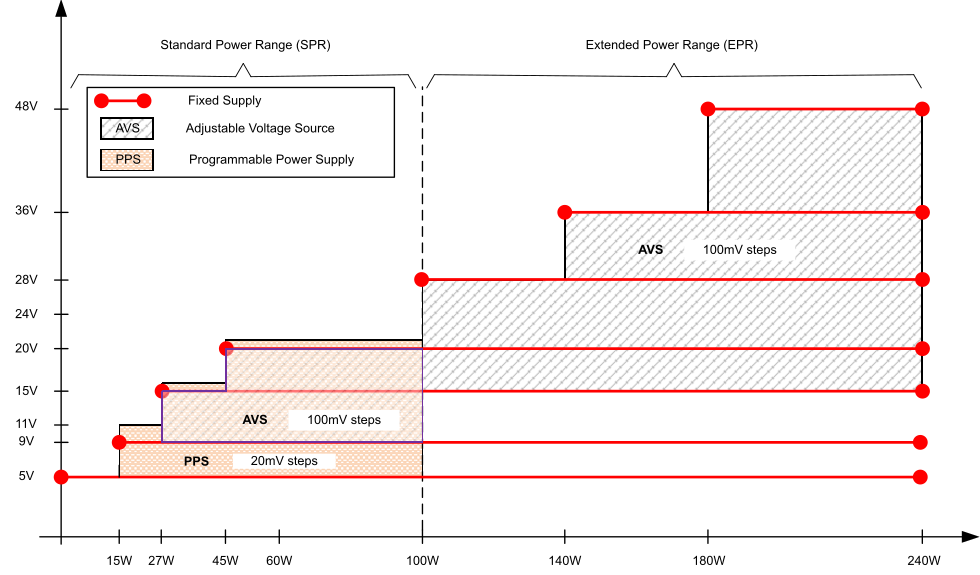
Diagram source: https://www.ti.com/document-viewer/lit/html/SSZTD49
Other facts about the standard:
-
USB-IF certifies USB PD chargers both with and without PPS. PPS is mandatory for the Certified USB Fast Charger category, but not for all USB-IF certified USB PD chargers.
-
MediaTek Pump Express (PE) 4.0 is compatible with USB PD 3.0 PPS.
➡️ If you need a charging adapter or power bank with tested load performance and confirmed support for charging protocols, check this selection of charging adapters.
➡️ If you need a USB-C cable for device charging or high-speed data transfer, take a look at the tested cables with measured internal resistance and data from the e-marker chip.
PPS/AVS charging support in devices from different manufacturers
Apple
-
Along with the release of the iPhone 17 Pro and iPhone 17 Pro Max, Apple introduced the 40W Dynamic Power Adapter with 60W Max with support for PD 3.2 SPR AVS and dynamic output power up to 60W.
-
Google Pixel 9 Pro requires PPS 11V to reach 27W charging power
-
Google Pixel 9 Pro XL requires PPS 21V to reach 37W charging power. The device does not accept PPS 20V; if PPS 21V is unavailable, it charges via PPS 11V. A PPS range up to 21V is not available on every USB charger, but suitable models are available.
-
Google Pixel 10, 10 Pro, and 10 Pro Fold require PPS 11V to reach 27W charging power.
-
Google Pixel 10 Pro XL requires PPS 21V to activate the maximum charging power of 37W (Rapid Charging); actual charging power is about 34W. If a charger supports PPS only up to 9V, 16V, or 20V, the smartphone uses PPS 9V and charges at up to 25W. With fixed-voltage PD only, it uses 9V and charges at up to 18W. A regular 3A cable is sufficient for these modes.
-
Pixel 11: 7.5-30W, PPS 11V/3A (documentation)
-
Pixel 11 Pro: 7.5-30W, PPS 11V/3A (documentation)
-
Pixel 11 Pro XL: 7.5-45W, PPS 21V/2.5A (documentation)
-
Pixel 11 Pro Fold: 7.5-30W, PPS 11V/3A (documentation)
HONOR
HUAWEI
-
Mate 70 Air - PPS 11V3A (up to 25W) and PD (9V - 12W max)
-
Mate 80 Pro - PPS 11V5A (up to 55W) and PD (9V - 12W max)
-
Pura 90 Pro Max - PPS 11V5A (up to 49W) and PD (9V - 13W max)
-
Pura X Max - PPS 11V5A (up to 55W) and PD (9V - 12W max)
iQOO
-
iQOO Neo11 supports PPS 11V5A (around 44W) and PD (9V - 21W max)
Infinix
-
Infinix Note 50 Pro supports PPS 11V5A charging (approximately 34W). When charging from the PD protocol, charging is possible at a fixed PDO of 5V, 9V3A (17W max).
Nothing
-
Nothing Phone (4a) Pro supports PPS 11V5A (around 27W) and 20V5A/21V5A (around 46W)
Nubia
-
Nubia uses a modified PPS protocol to achieve charging power up to 165W (3.6-20V/8.25A), which requires a proprietary charger and a USB-C - USB-C 9A cable. Nubia chargers also support standard PD and PPS protocols, while Nubia smartphones can charge from some third-party chargers via PD/PPS at up to 90W.
OnePlus
-
15 - 55W (specs) (actual charging power around 44W), require PPS range 11V5A
-
15T - 55W (specs) (actual charging power around 44W), require PPS range 11V5A
-
Turbo 6 - 55W (specs) (actual charging power around 43W), require PPS range 11V5A
-
Turbo 6V - 55W (specs)
-
Ace 6 - 55W (specs)
-
Ace 6T - 55W (specs)
-
Ace 6T Genshin - 55W (specs)
-
Ace 6 Ultra - 55W (specs)
OPPO
-
Find X9 can use PPS 11V5A as an alternative and reach around 42W of charging power, resulting in charging times close to those with the original SuperVOOC 80W (Reddit post). The theoretical maximum is 55W (specs).
-
Find X9 Pro - 55W (specs)
-
Find X9 Ultra - 55W (specs)
-
Find X9s Pro - 55W (specs)
-
Find N6 - 55W (specs)
-
Reno15 - 55W (specs)
-
Reno15 Pro - 55W (specs)
-
Reno15c - 55W (specs)
-
K13 Turbo Pro 5G - 33W (specs)
-
A6 - 44W (specs)
-
A6s - 33W (specs)
-
A6s Pro - 55W (specs)
-
A6k - 33W (specs)
-
K15 Pro - 55W (specs)
-
K15 Pro+ - 55W (specs)
-
F31 Pro+ - 33W (specs)
➡️ If you need a charging adapter or power bank with tested load performance and confirmed support for charging protocols, check this selection of charging adapters.
➡️ If you need a USB-C cable for device charging or high-speed data transfer, take a look at the tested cables with measured internal resistance and data from the e-marker chip.
realme
Redmi
-
Turbo 5 Max supports PPS and can be charged up to 82W (real charging). To get that performance, 20V5A or 21V5A PPS support is required from a charger.
Samsung
-
It is important to know that many chargers that advertise fast charging do not reach the maximum charging speed for Samsung devices. Samsung Galaxy devices, including models in the S20-S26 Plus and Ultra series, require a charger with a specific PPS range and supported current to achieve maximum charging speed. More information about Samsung devices is available here: Super Fast Charging (SFC)
Vivo
-
Y300 Pro supports PPS up to 35W (9V)
-
X100 Pro well supports PPS charging. In case of up to 11V5A charging range, you may get 30-40W, with a range up to 21V5A you may get almost 80W (there is no confirmation, but it is supposed that 20V5A range might give around 65W).
-
X200 Pro supports PPS 11V5A charging at around 45W; other PPS ranges are not supported. When charging via a fixed PD PDO, 9V3A is available, with about 11W maximum.
Xiaomi
-
12S Pro (in addition to the proprietary charging protocol) supports PPS ranges up to 11V and 16V (actual charging power around 15W) and PD 9V (power around 9W).
-
13 Ultra/Pro/13T Pro (in addition to the proprietary charging protocol) supports PPS ranges up to 11V (actual charging power is about 26W) and PD 9V (power is about 13W).
-
15 Pro (in addition to the proprietary charging protocol) supports PPS ranges up to 11V (actual charging power about 26W) and PD 9V (power about 13W)
-
17 supports 100W PPS (official media)
-
17T supports 50W PPS (specs)
-
17T Pro supports 100W PPS (specs)
-
17 Ultra supports 90W PPS (specs)
-
17 Pro Max (in addition to its proprietary charging protocol) also supports other protocols
-
PPS up to 11V5A - actual charging power around 43W,
-
PPS up to 20V5A/21V5A - actual charging power of 53W with a 3A cable and 78W with a 5A cable
-
PD 9V - charging power around 15W
-