

How to power Starlink Mini at home, in the car and while camping

Starlink can be powered by a mains USB-C charger, a power bank or a portable power station. Compatibility depends on the terminal model, the charger's output mode and the cable. Starlink Mini officially supports power via USB Power Delivery. Here is what you need to use it at home, in a car or at a campsite, and how much energy to store for several hours of connectivity.
Which Starlink models support USB-C PD
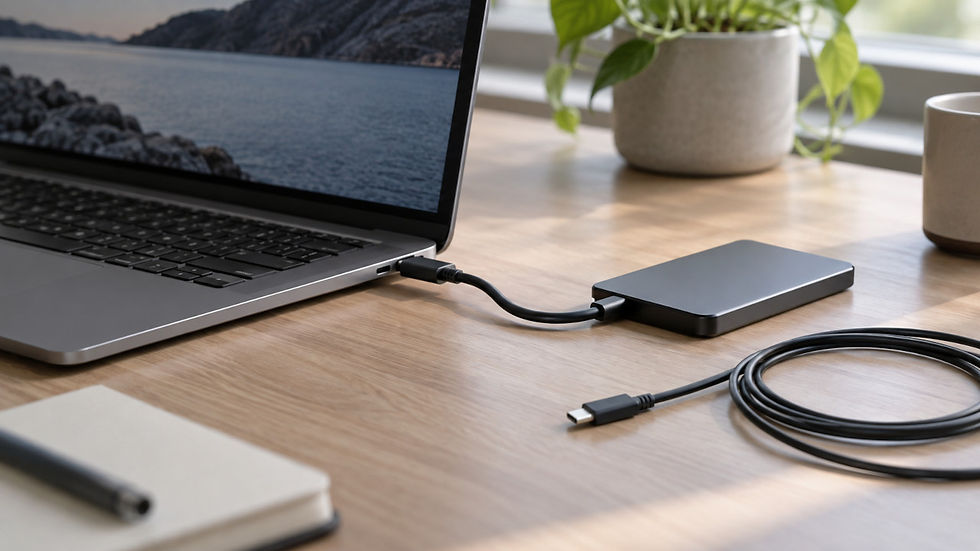
The Starlink Mini specification requires a USB PD source rated at least 100W with a 20V5A mode. Connect it using the dedicated Starlink USB-C-to-barrel cable: the charger end uses USB-C, while the terminal end has a round 5.5x2.5mm DC connector.
Mini X includes the same Mini terminal (with built-in WiFi 5) and an additional Router Mini (WiFi 6). The 20V5A requirement applies to the terminal. The external router needs a separate power supply, for which no dedicated USB PD cable is provided. However, this router requires 9V1.6A, so it can also be connected to a USB-PD charger using a cable designed for a fixed 9V output. This would be an unofficial third-party solution.
Router Mini is optional for standalone use: the Mini terminal already has built-in Wi-Fi. One suitable USB-C output therefore powers both the antenna and its built-in router.
Mini also has Ethernet LAN: you can connect a laptop by cable without using WiFi. However, plugging in the cable does not switch off Wi-Fi, so it will not reduce power consumption in this way.
How to choose a charger and cable
Look for 100W on a single USB-C port and a fixed 20V5A mode. A multiport charger's total power rating does not guarantee this mode on the port you need. For example, connecting a laptop to a second port may change power allocation and interrupt Starlink's power supply. Check the output mode table for the exact combination of devices you plan to use simultaneously.
For home use, a mains USB-C PD charger is suitable. The Starlink cable negotiates the power supply and connects to the Mini's DC connector.
How much energy Starlink Mini needs for 1, 3 and 6 hours
Mini's official specification lists average power consumption of 25-40W and 15W when idle. This range is useful for initial planning, while the 100W source requirement concerns power compatibility. Do not assume that Mini continuously uses 100Wh per hour or that 40W is a guaranteed limit in all conditions: consumption varies during operation.
Load energy is calculated as follows: Wh = W × hours.
When calculating the required battery capacity (a power bank or portable power station), allow for losses during energy conversion and transmission. Assuming losses of 20%, divide the energy needed by Starlink by 0.8:
1 hour: 25-40Wh of energy; a practical battery capacity guideline is at least 50Wh.
3 hours: 75-120Wh of energy; a battery capacity guideline is at least 150Wh.
6 hours: 150-240Wh of energy; a battery capacity guideline is at least 300Wh.
Heating to remove snow increases consumption, so winter runtime requires extra capacity or measurements of your own system.
When choosing a portable power source, check its capacity in Wh. For example, 20000mAh at 3.7V corresponds to a nominal 74Wh before losses (about 1.5 hours). Such a power bank must also support a 20V5A output.
Runtime: power bank or portable power station?
For short trips, a high-power power bank is convenient. For several hours of connectivity, a laptop and lighting, a higher-capacity power station is more useful. USB-C power avoids the need to turn on the AC inverter, making energy use more efficient.
For camping, consider the Anker SOLIX C300 DC power station (288Wh). The Anker manual confirms a dedicated USB-C1 output of 100W 20V5A, two bidirectional USB-C2/C3 ports rated at 140W each, and an XT60 solar input of 11-28V, up to 100W. This does not mean it cannot be connected to a more powerful solar panel: charging power is simply limited to 100W. You can therefore charge the station via PD or a solar panel, while connecting Mini to a separate port.
With estimated losses of 20%, 288Wh provides about 5-5.5 hours of operation for Starlink Mini alone.
For longer camping trips, charging a laptop and other accessories, and lighting, consider Anker SOLIX C1000 (1056Wh). The Anker manual confirms a 100W 20V5A USB-C output and an XT60 solar input of 11-60V, up to 600W. USB-C is output-only here: C1000 charges through AC or its solar/car input. With the same estimated losses, runtime is about 20 hours for Mini alone at 40W. Other devices will naturally reduce this time.
Solar power and use in a car
For solar power, consider the folding Renogy E.FLEX 200W panel. Its built-in USB-C adapter supplies only 45W and can charge gadgets in parallel. However, this does not use the panel's full potential, so you need to use its DC output. A 200W panel provides more headroom relative to Mini's consumption, but its rated power is not guaranteed in cloudy weather.
You cannot connect a solar panel directly to Starlink Mini. To smooth fluctuations in incoming energy and store the surplus during sunny periods, connect the panel's MC4 output to a compatible MPPT controller input on a portable power station (the SOLIX C300/C1000 mentioned above), in this order: panel MC4 → MC4-to-XT60 cable → station solar input → USB-C PD → Starlink PD-DC cable → Mini.
If you have a power bank with pass-through mode (simultaneous charging and power output), you can use it as a buffer between the solar panel and Starlink Mini. Power banks usually lack a direct DC input for connecting a solar panel, so you will need another intermediate module with a 5.5x2.5 DC input between the panel and the power bank, such as a DC-PD3.1 module with a specified input of 12-32V, which offers more voltage headroom. Connect this module to the solar panel using the BougeRV Solar Connector-to-DC adapter cable with a DC5525 tip.
An alternative is SlimQ M0002: 5-24V input, DC5525. This module has 4 USB-C connectors, allowing you to connect and charge several devices simultaneously.
While driving, you can also connect and charge your devices, including Starlink, using powerful car PD chargers, which must be capable of delivering 20V5A at least briefly.
Remember to protect the USB-C connection, charging modules, power bank, portable power station and Starlink terminal from water.