How to charge OPPO, OnePlus and realme smartphones?
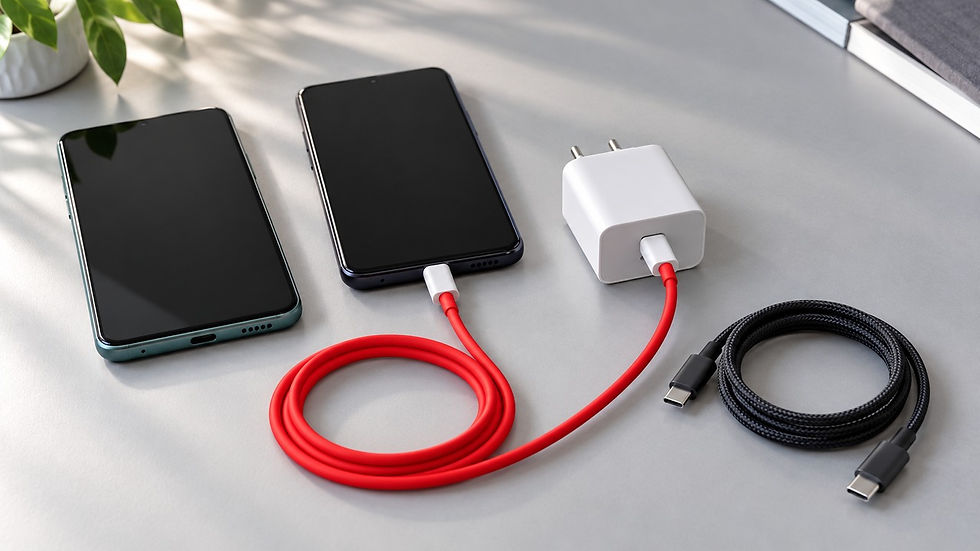
The included charger charges your smartphone quickly as long as it is available and working. But what should you choose if the adapter is lost, stops working or you need an extra charger for the car and travel? For OPPO, OnePlus and realme, the choice depends on more than the power rating printed on the case: the protocol, port and cable all matter.
VOOC, SuperVOOC, Dash, Warp and Dart: related technologies
Fast charging on smartphones from these brands relies on the VOOC and SuperVOOC family. OnePlus used the names Dash Charge and Warp Charge at different times, while realme used Dart and SuperDart. Modern devices from all three brands use the name SuperVOOC, also abbreviated as SVOOC.
For a time, SuperVOOC was used only in the top smartphone models from these brands.
These names refer to a related family of technologies, but do not imply identical power or full compatibility across all generations. For example, support for early VOOC is not the same as support for high-power SuperVOOC. The capabilities of the specific smartphone, charger and cable need to be considered together.
Charging at the maximum proprietary power requires a compatible protocol in the adapter and a suitable cable. A regular USB-C charger rated at, for example, 100W or 140W does not replace SuperVOOC by itself: its high power may be available through a different protocol that the smartphone uses at a lower limit.
The manufacturer often includes a suitable adapter with the smartphone, although the contents of the box depend on the model and market. If a replacement is needed, an original compatible charger remains the most obvious option. However, the proprietary protocol is also found in other devices, including power banks, car adapters, and modules with a DC input.
Which cable do you need for SuperVOOC?
High-power versions of SuperVOOC can draw 10A or more. These modes require a proprietary high-current cable compatible with the smartphone and adapter. Depending on the charger, it may be USB-A - USB-C or USB-C - USB-C: the connector shape alone does not determine support for the mode.
A standard USB-C - USB-C cable marked 100W or 240W is rated for up to 5A under the Power Delivery protocol. The 240W marking means operation at a higher USB PD 3.1 EPR voltage (up to 48V), rather than the ability to carry 10A. Such a cable therefore does not replace a proprietary high-current cable for maximum SuperVOOC power.
An original cable is not required in every situation, however. Based on Tinker Vault's practical observations, a standard USB-C - USB-C cable marked 100W or 240W (5A) is sufficient for compatible SuperVOOC modes up to about 50W. The compatibility condition matters here: this means an adapter implementing SVOOC and a mode supported by the smartphone, rather than any charger with a suitable power rating.
For example, Tinker Vault's tests of the USB-C port on the AOHi Superauto 45W record VOOC/SVOOC operation with a standard cable. By contrast, the OnePlus SuperVOOC GaN 120W requires an original 10-12A cable for its maximum proprietary mode.
An example of a standard 5A PD 3.1 EPR cable is the Amazon Basics USB-IF Certified TBT4 240W. Its specifications and measurement results are listed in the Tinker Vault catalog. Such a cable is also useful for standard PD/PPS charging.
Where can you find a charger with VOOC/SuperVOOC?
Support for this protocol family is less common than USB PD and PPS. The devices below come from the Tinker Vault catalog and are worth considering for different uses. A device's total power does not guarantee that a particular smartphone will get the maximum charging power (for example, 120W): each smartphone has its own charging limits.
OnePlus SuperVOOC GaN 120W 1C1A. An original wall adapter with USB-C and USB-A. According to the catalog, SuperVOOC is available from both ports, up to 120W on a 230V mains supply and up to 80W on 110V. Maximum power requires a proprietary 10-12A cable; a USB-C - USB-C cable is included. PD/PPS support up to 65W is also provided. Power allocation changes when both ports are used.
SHARGE POUCH P065B 10k mAh 2C + 40W 1C charger. A distinctive set combining a 10000mAh power bank with two USB-C ports and a magnetically attached wall adapter. Both devices support VOOC/SVOOC, making them useful for charging your smartphone at home and while traveling. A 5A cable is included.
AOHi Superauto 45W AOC-S001 (1C1A). A car adapter for 12V or 24V vehicle electrical systems. Tests of the USB-C port identified VOOC and SVOOC, including operation with a standard cable. Using USB-C and USB-A simultaneously changes the power mode, so consider whether the second port is occupied when fast charging a single smartphone.
Modules with a DC input
If you already have a suitable DC power source, you can use a module that adds a USB output and the charging protocols you need. This is an option for DIY builds or stationary power; choose the input voltage and connection according to the module's specifications.
XY-PDS100 DC/PD to USB(1C1A). A module with a DC or USB PD input and USB-C and USB-A outputs. The site's tests identified VOOC on USB-A. It should not automatically be considered a replacement for a high-power SuperVOOC charger.
SW3538 140W Black module (1C1A). A module with a 6-30V DC input and VOOC/SVOOC support, confirmed by the site's tests on USB-C and USB-A. The 140W in the name refers to a separate nonstandard 20V7A mode, rather than guaranteed SuperVOOC power for a smartphone.
SW3538 140W Blue module (1C1A). Another version of a module with a 6-30V DC input, with VOOC/SVOOC also confirmed by tests. Despite the name, testing found that its maximum PD output is limited to 100W.
SW3538 modules use a step-down design: the output voltage depends on the input supply. The required protocol therefore needs to be checked together with the power source requirements, rather than on its own.
Can you use a regular PD/PPS charger?
Modern OPPO, OnePlus and realme smartphones, especially higher-end models, may also support standard fast charging protocols: USB PD, PPS and UFCS. The protocol selection and power limit depend on the specific model and regional version. Supporting one of them does not imply support for the others.
For example, PPS up to 55W is supported by realme Neo8, OPPO Find X9 Pro, OPPO Find X9 Ultra, OnePlus 15, and many other smartphones from these brands (you can check compatibility using the protocol links above).
The PPS modes up to 55W discussed here require a 5A USB-C - USB-C cable and a charger with a suitable PPS range and current rating.
Alternative charging protocols such as PPS/UFCS can be a convenient option if you want to use one adapter for your smartphone, laptop, and other devices. Smartphone charging power is usually lower than the proprietary SuperVOOC maximum, but the choice of compatible chargers is much wider.